Should Your Business Let an AI Agent Act on Its Own?
A practical way to decide which business tasks an AI agent can handle, which need review, and which should stay under human control.
An AI agent should act on its own only when the task is clearly bounded, its result can be checked, and a mistake is easy to reverse. For tasks involving money, customers, legal commitments, or access to sensitive data, keep a person in the approval loop.
The question isn’t simply whether an agent can complete a task. It’s whether your business can detect, contain, and fix a mistake before it causes harm.
Start with the cost of a mistake
An agent uses a model to decide what steps to take and can use tools to act on those decisions. That can help with work involving several steps or information in different formats. It also means the system may do more than produce text: it might update a record, send a message, or trigger another process.
OpenAI’s practical guide recommends human oversight for sensitive or irreversible actions, such as authorizing large refunds or making payments, at least until reliability is established.
Turn that into a simple question:
If the agent gets this wrong, can we notice quickly and undo the result?
If the answer is no, the task needs stronger review or tighter limits.
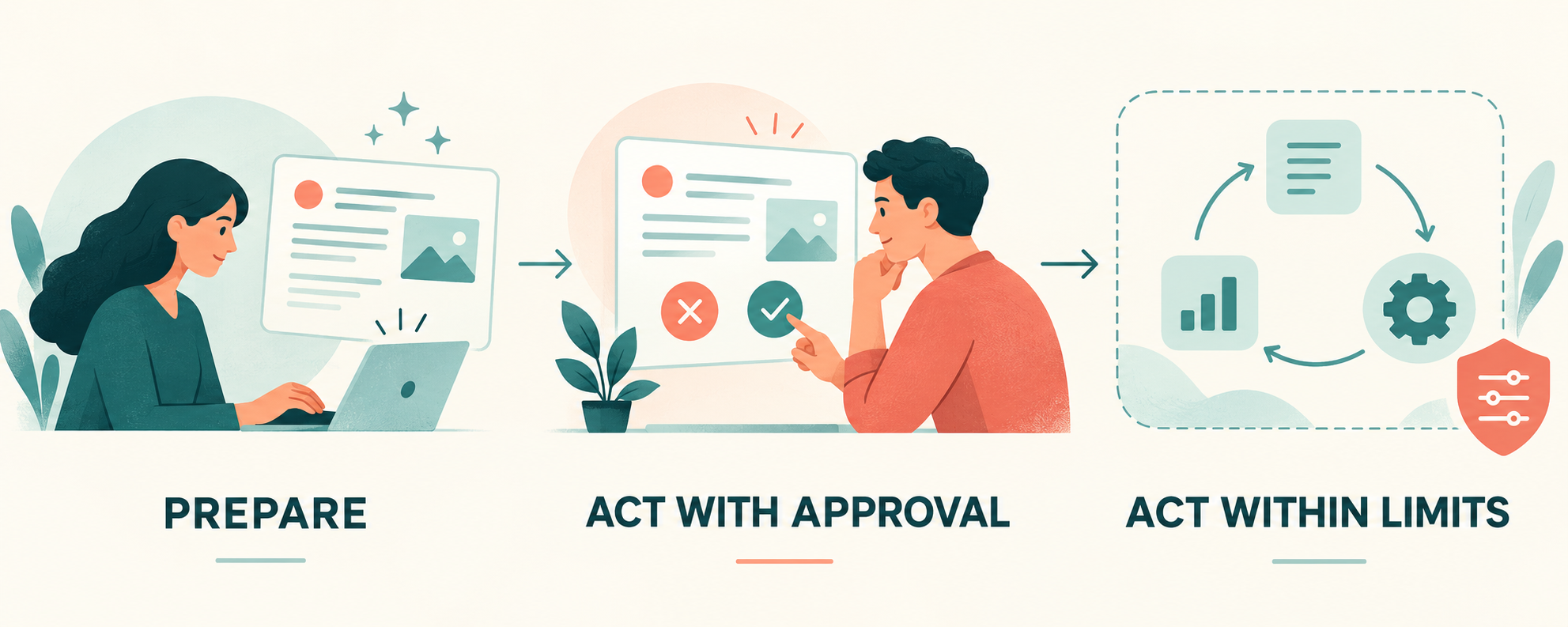
Use three levels of autonomy
This framework is an independent decision aid, not a guarantee that a task is safe.
Prepare
The agent gathers information and suggests a next step. A person decides what happens. Example: summarize a support request and suggest a reply.
Act with approval
The agent prepares an action, then waits for a person to approve it. Example: draft a customer response or a payment for review.
Act within limits
The agent completes a narrow, reversible action, with records and a clear way to stop it. Example: label an incoming request or route it to a team queue.
Start with the first level. Move up only when you have evidence that the agent handles real cases as expected, not just a polished demonstration.
Check five things before removing a review step
Is the task specific? “Handle customer support” is too broad. “Classify incoming messages into these five categories, and route anything uncertain to a person” is more testable.
Can you check the result? Decide what a correct outcome looks like before the agent goes live. For example: the correct category was chosen, relevant information was captured, and ambiguous cases were flagged rather than guessed.
Can you undo the action? A label can usually be changed. A message sent to a customer or a payment made may not be so easy to reverse.
Are permissions narrow? Give the agent access only to the information and actions it needs. Limit what it can change, and set conditions for stopping or escalating.
Can you review what happened? Keep a record of inputs, actions, and outcomes so someone can understand and correct a problem.
OpenAI’s guidance also recommends clear instructions, well-defined tools, guardrails, and human intervention. Its Agents API announcement describes infrastructure for persistent sessions and tool use; those capabilities make longer-running agents possible, but don’t establish that any particular task is appropriate for unsupervised use.
A hypothetical example: sorting project inquiries
Imagine a small agency that receives project inquiries through a form. A first version of an agent could extract the requested service, timeline, and contact details, then prepare a short summary for review.
If the summaries are consistently useful, the agency might let the system route inquiries into internal queues. Sending a reply that promises a price, timeline, or service availability is a different action: those details depend on current business decisions, so a person should verify them first.
This example is illustrative, not a SENORJOB client result or a description of a live system.
When a simpler automation is enough
Not every repeated task needs an AI agent. If the steps are predictable and the rules are clear—such as sending a standard internal notification when a form arrives—a conventional automation may be easier to test and maintain.
An agent is more useful when the work requires interpreting varied information or choosing between several possible next steps. Even then, use a fixed workflow for the parts that don’t need judgment, and reserve the model for the parts that do.
A practical first step
Choose one recurring task with a clear owner and a low cost of error.
Write down the expected input, output, and exception cases.
Have the agent prepare results without taking external action.
Compare its work with a person’s decisions over real examples.
Track errors, corrections, and cases it should have escalated.
Add a narrow action only when the results justify it; keep approval for high-impact decisions.
The goal is not maximum autonomy. It’s finding the smallest, dependable amount of autonomy that makes a useful difference to the work.
Conclusion
Let an AI agent act on its own only when the task is narrow, the result is easy to check, and errors can be contained or reversed. Keep human approval where actions affect customers, money, commitments, or sensitive information. Start by having the agent prepare; earn autonomy through observed performance and clear limits.
AI-native technology agency
Have an idea worth building?
Bring us the ambition. We will shape the strategy, experience, and technology around it.
Start a project